- Conservation of Momentum
- the product of mass and velocity
- has something to do with two bodies colliding each other.
- something that gives strength to an individual
* states that:
- momentum is always conserved
- every moving object has momentum
* Momentum is a commonly used term in sports. A team that has the momentum is on the move and is going to take some effort to stop. A team that has a lot of momentum is really on the move and is going to be hard to stop. Momentum is a physics term; it refers to the quantity of motion that an object has. A sports team that is on the movehas the momentum. If an object is in motion (on the move) then it has momentum.
Momentum can be defined as "mass in motion." All objects have mass; so if an object is moving, then it has momentum - it has its mass in motion. The amount of momentum that an object has is dependent upon two variables: how much stuff is moving and how fast the stuff is moving. Momentum depends upon the variables mass and velocity. In terms of an equation, the momentum of an object is equal to the mass of the object times the velocity of the object.Momentum = mass • velocity In physics, the symbol for the quantity momentum is the lower case "p". Thus, the above equation can be rewritten asp = m • v
where m is the mass and v is the velocity. The equation illustrates that momentum is directly proportional to an object's mass and directly proportional to the object's velocity.
* Formula: p=mv
-Example:
1. Bullet shown in the picture collides to a fixed block.0, 2 s is the interaction time of bullet with block. If the velocity of the bullet is 250m/s after the collision, find the resistance of the block to the bullet.
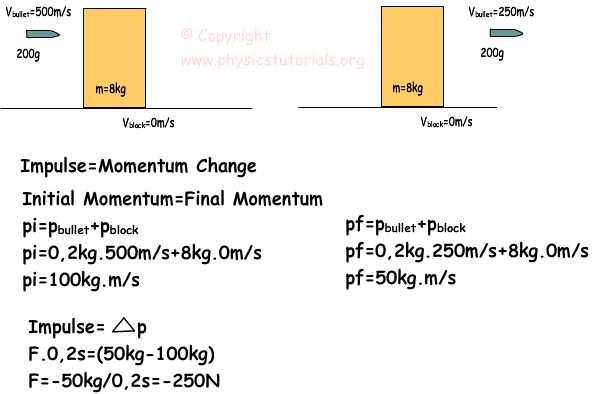
http://www.physicsclassroom.com/Class/momentum/u4l1a.cfm
- Impulse - the greater the force, the greater the impulse
- the greater the time, the greater the impulse
Newton's second law (Fnet = m • a) stated that the acceleration of an object is directly proportional to the net force acting upon the object and inversely proportional to the mass of the object. When combined with the definition of acceleration (a = change in velocity / time), the following equalities result.If both sides of the above equation are multiplied by the quantity t, a new equation results.This equation represents one of two primary principles to be used in the analysis of collisions during this unit. To truly understand the equation, it is important to understand its meaning in words. In words, it could be said that the force times the time equals the mass times the change in velocity. In physics, the quantity Force • time is known as impulse. And since the quantity m•v is the momentum, the quantity m•Δv must be the change in momentum. The equation really says that theImpulse = Change in momentum One focus of this unit is to understand the physics of collisions. The physics of collisions are governed by the laws of momentum; and the first law that we discuss in this unit is expressed in the above equation. The equation is known as the impulse-momentum change equation. The law can be expressed this way:In a collision, an object experiences a force for a specific amount of time that results in a change in momentum. The result of the force acting for the given amount of time is that the object's mass either speeds up or slows down (or changes direction). The impulse experienced by the object equals the change in momentum of the object. In equation form, F • t = m • Δ v.
* Formulas: Ft =
1. Force x time
2. mvf - mvi
3. Pf - Pi
-Example:
1.
Ans. Impulse=Force.Time Interval Impulse=15N.5s
Impulse=75N.s
2. Find applied force which makes 10m/s change in the velocity of the box in 5s if the mass of the box is 4kg.
Ans. Impulse=Change in momentumF.t=p2-p1F.t=m. (V2-V1)F.t=4kg.10m/s=40kg.m/s Impulse of the box is 40kgm/sF=40kg.m/s/5s=8N Applied force
http://www.physicsclassroom.com/Class/momentum/u4l1b.cfm


No comments:
Post a Comment