Tuesday, January 7, 2014

Rotation


  • Rotation       - is the motion of the body turning about an axis/around where all particles of a body moves at a circular point.
           - each linear quantity has its equal rotational quantity.

    Example:
    1. Rotation of the Earth
    2. Propeller
*Rotation
Angular Quantities


d = θ         d = df - di

Degrees (°), radians, revolution, rotation, cycle
    360°      =    2π      =       1          =       1      =   1

1/2π = 90° ,  π = 180°  , 3/4π = 270°


θ = 2
π    ,    C = 2π r ------------------> C =  θr


  • Angular Quantities
           d = vt -----> θ = ϖt           Vf = Vi + at -------> Wf = Wi + αt

               V = (V
f + Vi)/2 --------> ϖ = (Wf - Wi)/2
           d = Vit + 1/2at2 -------> θ = Wit + 1/2αt
           2ad = Vf2 - Vi2--------> 2αd = Wf2 + Wi2


  • Uniform Circular Motion
       - A body in circular motion is accelerating


    Centripetal Acceleration                                                Centripetal Force 
           Acp = V2/r2                                                                    Fcp = m
    ϖ2r

    Centrifugal Force
       - A force away from the center.


  • Newton's Law of Universal Gravitation
       
    -Just by picking a part of a flower, you are moving the farthest star.


    F = Gm
    1m2/d2                                                                              Where:                                                                                                                                                                         G = Gravitaional Constant                                                                                                     m1 = mass                                                                                                                                                               d = distance                                                                                                                                                               F = Gravitational Force
    G = 6.67 * 10-11   N.m2/kg2

    Isaac Newton compared the acceleration of the moon to the acceleration of objects on earth. Believing that gravitational forces were responsible for each, Newton was able to draw an important conclusion about the dependence of gravity upon distance. This comparison led him to conclude that the force of gravitational attraction between the Earth and other objects is inversely proportional to the distance separating the earth's center from the object's center. But distance is not the only variable affecting the magnitude of a gravitational force. Consider Newton's famous equation

    Fnet = m • a

    Newton knew that the force that caused the apple's acceleration (gravity) must be dependent upon the mass of the apple. And since the force acting to cause the apple's downward acceleration also causes the earth's upward acceleration (Newton's third law), that force must also depend upon the mass of the earth. So for Newton, the force of gravity acting between the earth and any other object is directly proportional to the mass of the earth, directly proportional to the mass of the object, and inversely proportional to the square of the distance that separates the centers of the earth and the object.
    But Newton's law of universal gravitation extends gravity beyond earth. Newton's law of universal gravitation is about the universality of gravity. Newton's place in the Gravity Hall of Fame is not due to his discovery of gravity, but rather due to his discovery that gravitation is universal. ALL objects attract each other with a force of gravitational attraction. Gravity is universal. This force of gravitational attraction is directly dependent upon the masses of both objects and inversely proportional to the square of the distance that separates their centers. Newton's conclusion about the magnitude of gravitational forces is summarized symbolically as
    Since the gravitational force is directly proportional to the mass of both interacting objects, more massive objects will attract each other with a greater gravitational force. So as the mass of either object increases, the force of gravitational attraction between them also increases. If the mass of one of the objects is doubled, then the force of gravity between them is doubled. If the mass of one of the objects is tripled, then the force of gravity between them is tripled. If the mass of both of the objects is doubled, then the force of gravity between them is quadrupled; and so on.
    http://www.physicsclassroom.com/Class/circles/

  • Law on Universal Gravitation and Weight 

                  Wt = G(mome)/d2                                                    Where:
                                                                                                  me = 5.98 * 1024 kg

                   Note : Radius of the Earth is equal to 6380 km      


  • States of Matter 
                *4 Kinds of Matter*
                      1. Solid - in terms of volume - definite
                  2. Liquid - in terms of volume - definite
                  3.Gas - in terms of volume - indefinite
                  4. Plasma - in terms of volume - indefinite
          -Plasma is the most common state of matter in the universe.                           

Monday, January 6, 2014

  • Conservation of Momentum
           - the product of mass and velocity
           - has something to do with two bodies colliding each other.
           - something that gives strength to an individual

     * states that:
           - momentum is always conserved
           - every moving object has momentum

    *        Momentum is a commonly used term in sports. A team that has the momentum is on the move and is going to take some effort to stop. A team that has a lot of momentum is really on the move and is going to be hard to stop. Momentum is a physics term; it refers to the quantity of motion that an object has. A sports team that is on the movehas the momentum. If an object is in motion (on the move) then it has momentum.
               Momentum can be defined as "mass in motion." All objects have mass; so if an object is moving, then it has momentum - it has its mass in motion. The amount of momentum that an object has is dependent upon two variables: how much stuff is moving and how fast the stuff is moving. Momentum depends upon the variables mass and velocity. In terms of an equation, the momentum of an object is equal to the mass of the object times the velocity of the object.

    Momentum = mass • velocity

    In physics, the symbol for the quantity momentum is the lower case "p". Thus, the above equation can be rewritten as

    p = m • v
    where m is the mass and v is the velocity. The equation illustrates that momentum is directly proportional to an object's mass and directly proportional to the object's velocity.

         
     * Formula: p=mv

    -Example:
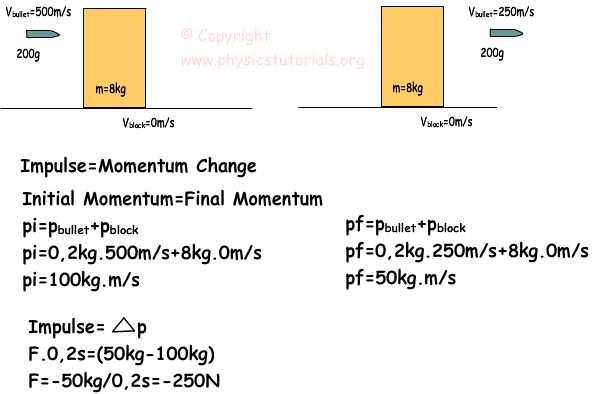
    1. Bullet shown in the picture collides to a fixed block.0, 2 s is the interaction time of bullet with block. If the velocity of the bullet is 250m/s after the collision, find the resistance of the block to the bullet.


http://www.physicsclassroom.com/Class/momentum/u4l1a.cfm

  • Impulse       - the greater the force, the greater the impulse
           - the greater the time, the greater the impulse

    Newton's second law (Fnet = m • a) stated that the acceleration of an object is directly proportional to the net force acting upon the object and inversely proportional to the mass of the object. When combined with the definition of acceleration (a = change in velocity / time), the following equalities result.
    If both sides of the above equation are multiplied by the quantity t, a new equation results.

    This equation represents one of two primary principles to be used in the analysis of collisions during this unit. To truly understand the equation, it is important to understand its meaning in words. In words, it could be said that the force times the time equals the mass times the change in velocity. In physics, the quantity Force • time is known as impulse. And since the quantity m•v is the momentum, the quantity m•Δv must be the change in momentum. The equation really says that the

    Impulse = Change in momentum

     
    One focus of this unit is to understand the physics of collisions. The physics of collisions are governed by the laws of momentum; and the first law that we discuss in this unit is expressed in the above equation. The equation is known as the impulse-momentum change equation. The law can be expressed this way:
    In a collision, an object experiences a force for a specific amount of time that results in a change in momentum. The result of the force acting for the given amount of time is that the object's mass either speeds up or slows down (or changes direction). The impulse experienced by the object equals the change in momentum of the object. In equation form, F • t = m • Δ v.

      * Formulas: Ft =
           1. Force x time
           2. mvf - mvi
           3. Pf - Pi

    -Example:
    1.


    Ans. Impulse=Force.Time Interval        Impulse=15N.5s
            Impulse=75N.s


    2. Find applied force which makes 10m/s change in the velocity of the box in 5s if the mass of the box is 4kg.
    Ans.
     Impulse=Change in momentum
    F.t=p2-p1
    F.t=m. (V2-V1)
    F.t=4kg.10m/s=40kg.m/s Impulse of the box is 40kgm/s
    F=40kg.m/s/5s=8N Applied force


    http://www.physicsclassroom.com/Class/momentum/u4l1b.cfm


  • Types of Collision

    *Perfectly Inelastic  (e = 0)
               mAVA + mBVB = (mA + mB) VA+B

    *Elastic (e = 1)  (K.E. is conserved)
                mAVA + mBVB = mAVA+ mBVB

    *Inelastic  (0 < e > 1)
                 mAVA + mBVB = mAVA' + mBVB'


  • Coeffecient of Restitution

    Formula:                                                         Kinetic Energy:
                                                                                  K.E. = 1/2mv(v)
   *Perfectly Inelastic    
          K.E.lost = K.E. - K.E.'
         
          K.E. = 1/2mA(VA)2 + 
1/2mB(VB)2

     K.E.' = 1/2(mA + mB)                         


Physics

Physics is the natural science that involves the study of matter and its motion through space and time, along with related concepts such as energy and force. More broadly, it is the general analysis of nature, conducted in order to understand how the universe behaves.

Physics is one of the oldest academic disciplines, perhaps the oldest through its inclusion of astronomyOver the last two millennia, physics was a part of natural philosophy along with chemistry, certain branches of mathematics, and biology, but during the Scientific Revolution in the 17th century, the natural sciences emerged as unique research programs in their own right. Physics intersects with many interdisciplinary areas of research, such as biophysicsand quantum chemistry, and the boundaries of physics are not rigidly defined. New ideas in physics often explain the fundamental mechanisms of other sciences while opening new avenues of research in areas such as mathematics and philosophy.


Physics also makes significant contributions through advances in new technologies that arise from theoretical breakthroughs. For example, advances in the understanding of electromagnetism or nuclear physics led directly to the development of new products which have dramatically transformed modern-day society, such as television, computers, domestic appliances, and nuclear weapons; advances in thermodynamics led to the development of industrialization; and advances in mechanics inspired the development of calculus.

http://en.wikipedia.org/wiki/Physics


  • Comet

      * Every 26 million years Earth will be hit by a comet.
  • Black Hole

     * Point of no return.
     * Greater than speed of light.
     * In 1967, John Michell called invisible stars as black holes.

  • Planetary Motion

    *Tycho Brache

    * Johannes Kepler
       -Three Laws of Planetary Motion
         1.First Law of Ellipses - The path of the planets about the sun is elliptical in shape, with the                                            center of the sun being located at one focus.

         2.The Law of Equal Areas - An imaginary line drawn from the center of the sun to the                                                       center of the planet will sweep out equal areas in equal intervals                                                 of time.      3.Harmonic Law --> (T1/T2)2 = (r1/r2) - 
    The ratio of the squares of the periods of any two planets is equal to the ratio of the cubes of their average distances from the sun.


    http://www.physicsclassroom.com/Class/circles/u6l4a.cfm